
We have spent several years helping medical students study for USMLE Step 1 and a consistent set of questions arise around dedicated study periods:
- “I have six weeks. Is that even enough time?”
- “Do I have to finish all the videos before I should start doing questions?”
- “My school already covered all of this, but I can’t remember most of it. Where should I start?”
- “I fell behind on a schedule I created. What am I doing wrong?”
These concerns share a common misconception: the belief in a single, universally correct Step 1 schedule. There isn’t one. This level of academic distress rarely stems from knowledge deficits; rather, it indicates a methodological misalignment. An effective study plan primarily depends on two variables:
- Available preparation time
- Strength of the student’s preclinical foundation
For example, a student with 12 weeks of a dedicated study period with significant knowledge gaps requires a fundamentally different approach from a student with 6 weeks who recently completed a rigorous, systems-based curriculum. Applying an identical schedule to different study profiles frequently results in undue anxiety and a perceived sense of failure among otherwise competent candidates.
Consequently, the Med School Bootcamp curriculum has continued to evolve to avoid prescribing a monolithic study trajectory. Instead, we provide two distinct scheduling philosophies designed to accommodate varying academic backgrounds. The purpose of this overview is to delineate these methodologies, and assist candidates in selecting the strategy that best aligns with their educational circumstances.:
- What is the duration of your dedicated preparation period?
- An allocation of 12 weeks or greater constitutes an extended preparation phase. Conversely, a dedicated study block of 4 to 8 weeks represents a more truncated timeline.
- How well did your curriculum prepare you?
- For example, did your institution provide a robust, structured preclinical program that comprehensively covered the requisite material, or do substantial deficits remain within your foundational knowledge base?
An extended preparation phase combined with foundational deficits strongly dictates a Full Review methodology. Alternatively, a truncated dedicated block following a comprehensive curriculum aligns more closely with a Qbank-focused approach. However, concordance between both variables is not always necessary; a definitive assessment of either parameter is sufficient to guide your selection. The subsequent sections outline the pedagogical rationale supporting these recommendations, which align with evidence-based medical education strategies.[1]
The Same Three Ingredients, Sequenced Differently
All Med School Bootcamp study schedules incorporate these primary components: didactic video lessons establishing core learning objectives, brief active-recall assessments, and question bank (Qbank) applications evaluating knowledge via standardized patient vignettes and chart questions.
The Qbank-focused approach prioritizes immediate evaluative testing. Candidates engage with clinical vignettes at the outset, utilizing the corresponding rationales, related video lessons, and illustrations as targeted remediation for identified knowledge deficits.
Conversely, the Full Review methodology prioritizes didactic instruction. Candidates acquire conceptual frameworks, validate comprehension via active recall, and subsequently integrate Qbank applications after a robust foundation is established.
Qbank-focused
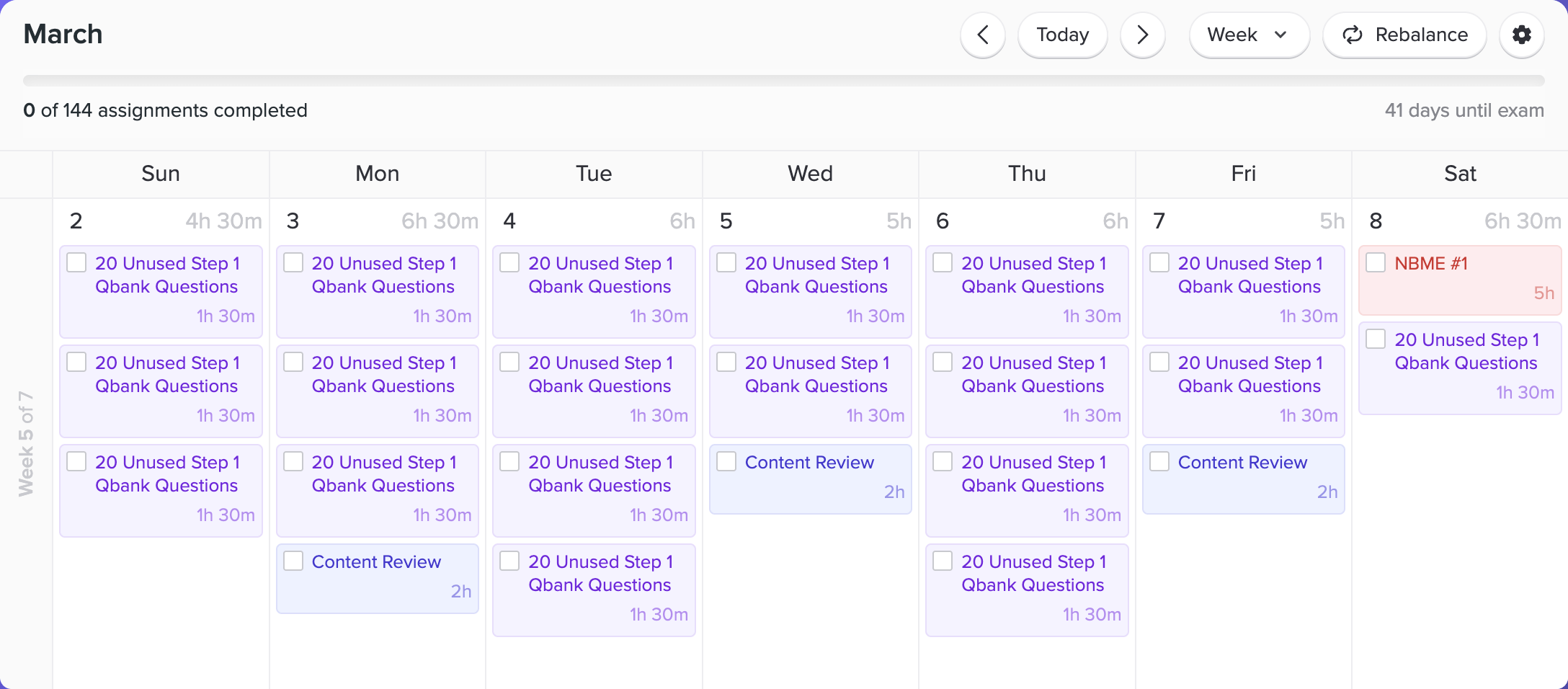
The Qbank-focused approach prioritizes question-based learning. This schedule addresses the evolving paradigm of the current USMLE Step 1 examination.[2] The modern assessment emphasizes the application of foundational sciences to realistic clinical vignettes, rather than the isolated recall of factual trivia (‘buzzwords’).[3] Engaging directly with these clinical scenarios is the most effective method for gaining analytical competency on exam day.
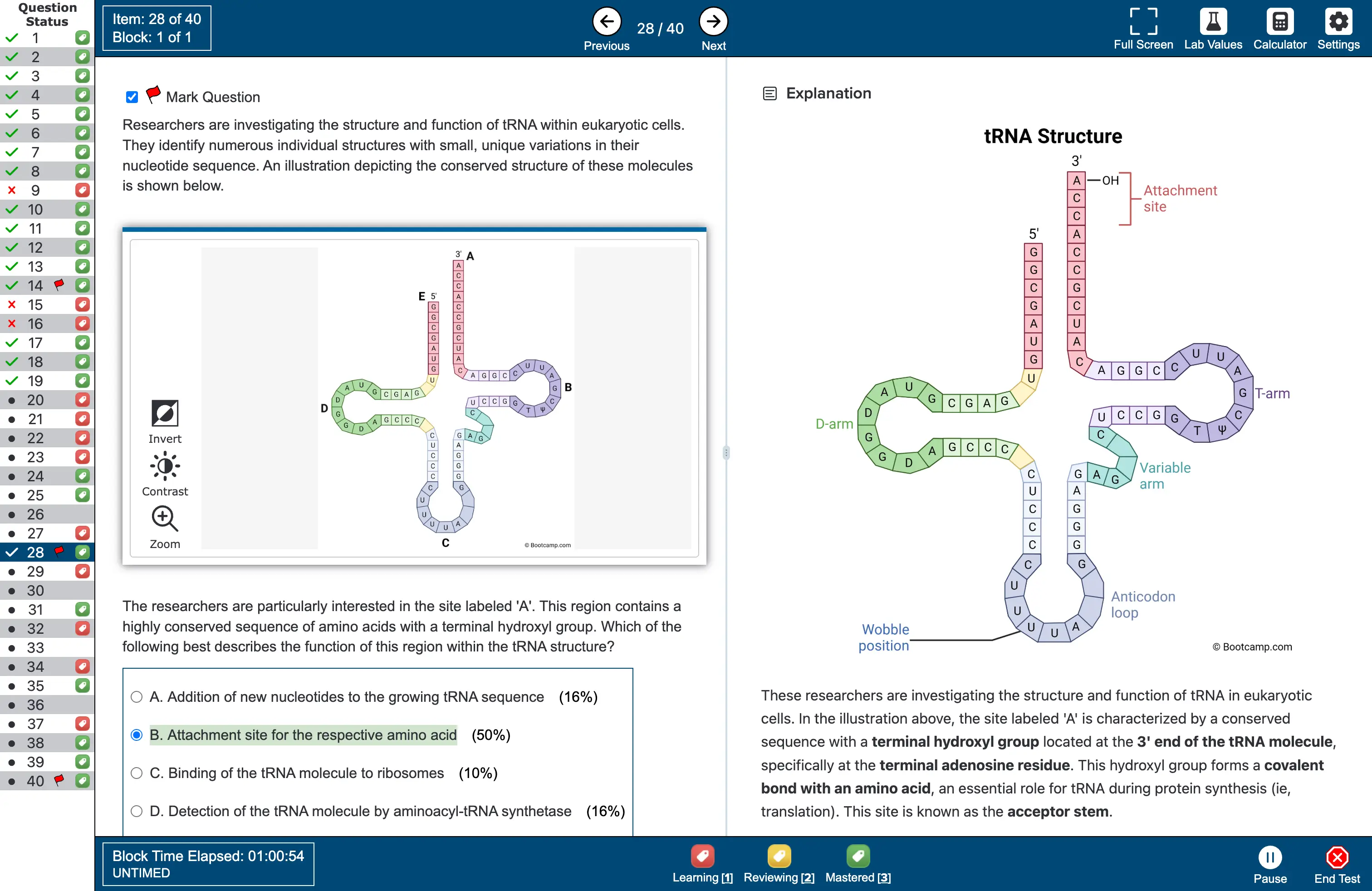
Consequently, the Qbank-focused schedule prioritizes question bank utilization from the onset of preparation. Incorrect responses function as targeted diagnostic tools: the comprehensive rationales elucidate the underlying medical principles, direct the candidate to pertinent didactic videos, provide modern visual aids, and integrate corresponding flashcards, all supplemented by expert physicians and artificial intelligence support.[4] This methodology ensures that specific knowledge deficits are identified objectively through individual performance metrics.
The Qbank-focused methodology is strongly indicated for candidates under the following conditions:
- Restricted dedicated study period (<12 weeks)
- Prior completion of a rigorous, structured curriculum targeting foundational knowledge in the basic sciences and organ systems
Full Review

The Full Review paradigm allocates predominant time to video lectures and active-recall assessments during the initial phases of study. As the examination date approaches, the academic focus progressively transitions toward Qbank applications. This ensures that extensive question-based evaluation serves to refine established cognitive frameworks rather than introduce novel concepts before the Step 1 examination.
The Systems-Based approach to content learning involves a highly structured, sequential progression through the curriculum, organized by individual organ systems or academic disciplines (eg, Cardiology, Pulmonology, Biochemistry). This variant is optimal for candidates seeking methodical mastery or those aligning their board preparation with concurrent institutional courses.
The Full Review approach is recommended under the following conditions:
- Extended preparation period (>12 weeks)
- Substantial deficits in foundational knowledge
- Preference for comprehensive didactic instruction prior to evaluative testing
How the Study Schedule Works
Regardless of the chosen philosophy, the underlying structural mechanics remain consistent and are engineered to accommodate the practical realities of intensive study periods. Upon inputting a start date and examination date, the platform generates a customized daily syllabus.
As the preparation period progresses, candidates can systematically track completion, adjust assignments to accommodate unforeseen disruptions, schedule necessary recuperation days, and recalibrate their academic pacing. This flexibility ensures that temporary deviations do not precipitate schedule failure. The schedule is designed with inherent elasticity to absorb academic disruptions while maintaining a continuous, directed study trajectory.
Build Your Schedule and See for Yourself
Med School Bootcamp provides a free 3-day trial period with full feature access, allowing sufficient time to input scheduling parameters, generate a customized syllabus, and evaluate whether the Full Review or Qbank-focused approach best suits your learning style. 1- and 2-year memberships are also supported by a passing guarantee for students attending accredited medical programs in the U.S. or Canada.
The USMLE Step 1 examination paradigm has evolved; consequently, preparation methodologies must adapt to reflect both the current examination structure and the candidate's available timeframe. The value of grounding study frameworks in evidence-based learning strategies is well established in the medical education literature.[6]
Create your personalized Step 1 Study Schedule today.
References
[1] Dunlosky J, Rawson KA, Marsh EJ, Nathan MJ, Willingham DT. Improving Students' Learning With Effective Learning Techniques: Promising Directions From Cognitive and Educational Psychology. Psychological Science in the Public Interest. 2013;14(1):4-58. (Rates practice testing and distributed (spaced) practice as the highest-utility, broadly generalizable evidence-based learning techniques, with interleaved practice rated as promising and recommended.) PMID: 26173288. DOI: 10.1177/1529100612453266.
[2] United States Medical Licensing Examination (USMLE). USMLE Step 1 Transition to Pass/Fail Only Score Reporting. USMLE.org. 2022. (Official record that Step 1 score reporting transitioned from a numeric score to pass/fail only for exams taken on or after January 26, 2022 - the concrete structural change behind the exam's evolved paradigm.)
[3] United States Medical Licensing Examination (USMLE). Step 1 Content Outline and Specifications. USMLE.org. Accessed 2026. (Official specification that 60-70% of items assess "Applying Foundational Science Concepts" and that the majority of questions require examinees to "solve problems through application of basic science principles" - i.e., application of foundational science rather than isolated fact recall.)
[4] Larsen DP, Butler AC, Roediger HL. Test-enhanced learning in medical education. Medical Education. 2008;42(10):959-966. (Establishes, in the medical-education context, that feedback is crucial to learning from tests - it helps students correct errors and confirm correct answers - supporting incorrect responses functioning as diagnostic tools.) PMID: 18823514. DOI: 10.1111/j.1365-2923.2008.03124.x.
[5] Roediger HL, Karpicke JD. Test-enhanced learning: taking memory tests improves long-term retention. Psychological Science. 2006;17(3):249-255. (Experimental evidence that on delayed tests, prior testing produced substantially greater retention than repeated studying - supporting active recall and iterative testing over passive review.) PMID: 16507066. DOI: 10.1111/j.1467-9280.2006.01693.x.
[6] Madan CR. Using Evidence-Based Learning Strategies to Improve Medical Education. Medical Science Educator. 2023;33(3):773-776. (Editorial reviewing six validated, evidence-based learning strategies - spacing, interleaving, retrieval practice, elaboration, dual coding, and concrete examples - and their application within medical education.) PMID: 37501813. DOI: 10.1007/s40670-023-01798-9.


Get everything you need in one place. Start studying today for free.