


- Your Candidate Performance Report (CPR) is a report NCSBN sends every candidate who doesn't pass the NCLEX. It's the only feedback you'll get on your performance.
- It rates you across 15 individual performance lines as Above, Near, or Below the Passing Standard.
- Our free NCLEX Bootcamp CPR Analyzer turns those ratings into a personalized study plan.
If you failed the NCLEX, read this...
Failing the NCLEX is discouraging, but it's not rare and it doesn't determine your career. What matters now is having a smart plan for your retake. The most important document you have to build that plan is your Candidate Performance Report (CPR).
Understanding your CPR can be confusing and overwhelming. All that feedback might leave you wondering, "What exactly should I focus on now?"
What is the CPR?
The CPR is a report NCSBN sends every candidate who doesn't pass the NCLEX. It's the only feedback you'll get on your performance. Instead of a number score, it rates you across the test plan with three labels:
- ABOVE THE PASSING STANDARD: You performed above the minimum competency.
- NEAR THE PASSING STANDARD: You performed in proximity to the passing standard, but this does not mean you performed at or above it.
- BELOW THE PASSING STANDARD: You performed below the minimum competency.
Your official results are sent to you by your Board of Nursing (not by NCSBN or Pearson VUE) and will arrive within six weeks after your exam. The CPR comes with those official results. The timeline can vary across state nursing regulatory bodies, so contact your Board of Nursing if you have questions about timing.
What a CPR actually looks like
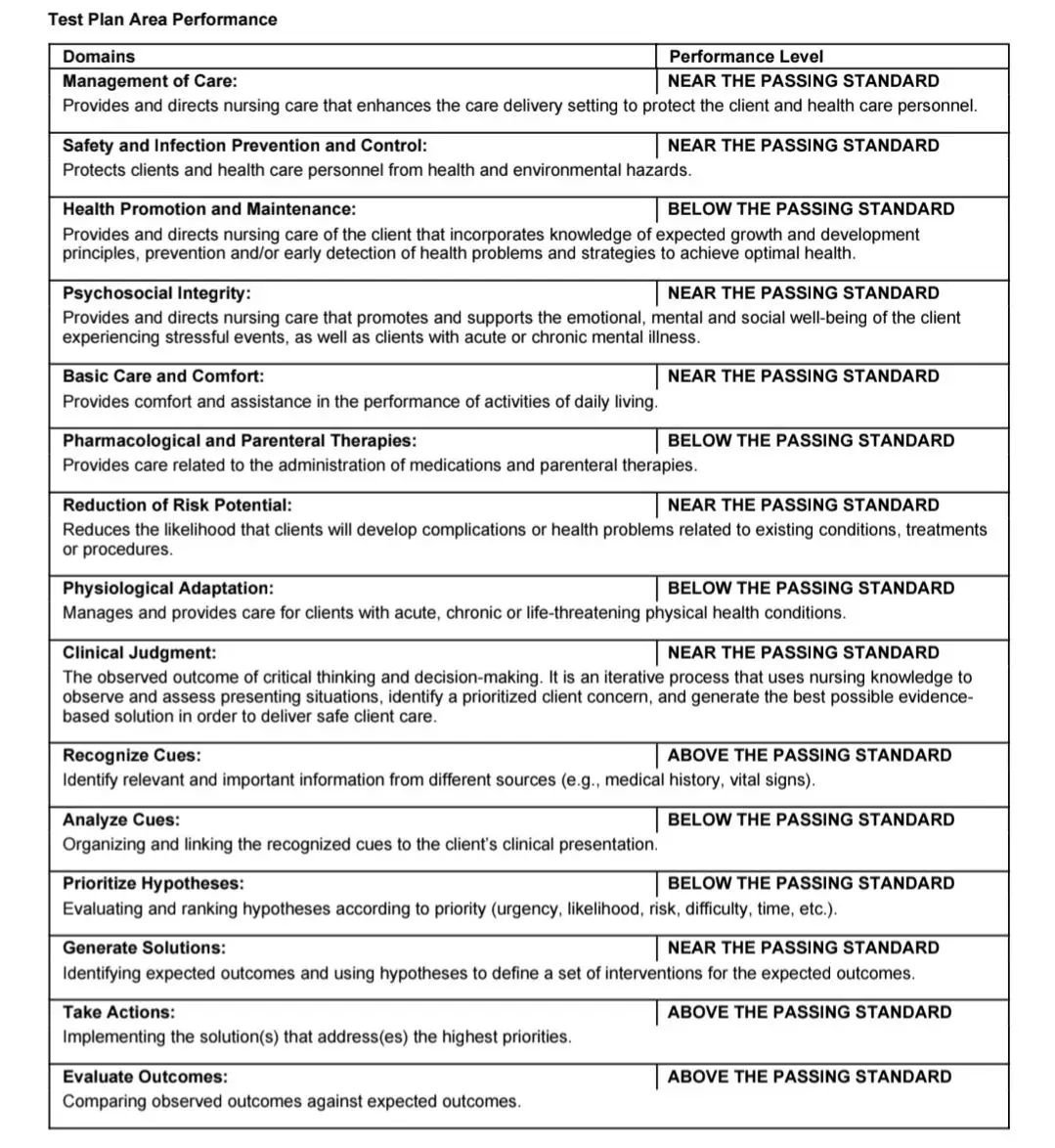
The report is organized into one table called Test Plan Area Performance, split into two blocks:
Block 1 — Client Needs: Management of Care, Safety and Infection Prevention and Control, Health Promotion and Maintenance, Psychosocial Integrity, Basic Care and Comfort, Pharmacological and Parenteral Therapies, Reduction of Risk Potential, Physiological Adaptation.
Block 2 — Clinical Judgment: An overall Clinical Judgment rating, plus the 6 sub-skills from the NCSBN Clinical Judgment Measurement Model — Recognize Cues, Analyze Cues, Prioritize Hypotheses, Generate Solutions, Take Actions, Evaluate Outcomes. The overall Clinical Judgment line summarizes the same construct measured by those six steps. It is not a separate, independent category.
Block 1 tells you what content to review. Block 2 tells you how to think differently on test day.
Let our CPR Analyzer do the work
If reading your CPR feels like a lot, our free NCLEX Bootcamp CPR Analyzer handles it for you. Upload your CPR and it will:
- Identify your strengths and weaknesses across all performance lines.
- Build a personalized improvement plan mapped to NCLEX Bootcamp content.
- Recommend strategies based on your Clinical Judgment pattern — not just your content gaps.
What to do next
Once you know your gaps, your next step is a structured retake plan. NCSBN requires a minimum 45-day waiting period between exam attempts — your state Board of Nursing may require a longer wait, so verify with your NRB before scheduling your retake date.
You've got this.
Your CPR is a map. Use it. If you have questions about your report, our NCLEX expert educators are here to help.





Get everything you need in one place. Start studying today for free.





