
.jpg)
I prepared for the DAT while attending UCLA as a full-time undergraduate, balancing a demanding academic course load alongside my preparation. Because of this, maintaining discipline and consistency in my study routine was essential. At the same time, I found it helpful to occasionally step away from studying to recharge through activities I enjoy, such as music production, piano composition, and tennis. Even something as simple as taking a short walk helped reset my mind and make complex concepts easier to process. Maintaining this balance allowed me to stay productive while keeping my academic goals as the clear priority.
I began studying toward the middle of the fall quarter while managing a large course load and studied approximately 5 hours each day. One strategy that helped me tremendously was studying a little bit of every DAT subject every day. Instead of focusing on a single subject for long periods of time, I allowed information to gradually “marinate.” Spaced repetition made concepts stick much more naturally over time. I approached the DAT like building a toolbox. Each day I tried to add new tools–different tactics, techniques, and problem-solving strategies–so that when I encountered a question on test day, I would already have the skills needed to approach it confidently. I personally only took one full-length practice exam. Most of my preparation focused on mastering each section individually and reinforcing concepts through targeted practice.
Biology
For Biology, I relied heavily on Bootcamp’s Bio Anki cards along with the practice exams, which I found to be extremely representative of the real DAT. I often reviewed Anki cards while walking outside with my iPad, and surprisingly, associating concepts with different environments helped reinforce my memory. A key strategy for Biology is focusing on breadth over depth. The DAT covers a wide range of topics, but most questions are high-yield rather than extremely detailed. If you prepare well, you will often see a question and immediately feel that one answer choice is correct. Trust that instinct, because it is usually right. Biology is also a section where strong preparation allows you to move efficiently, which can save valuable time for General Chemistry and Organic Chemistry.
General Chemistry
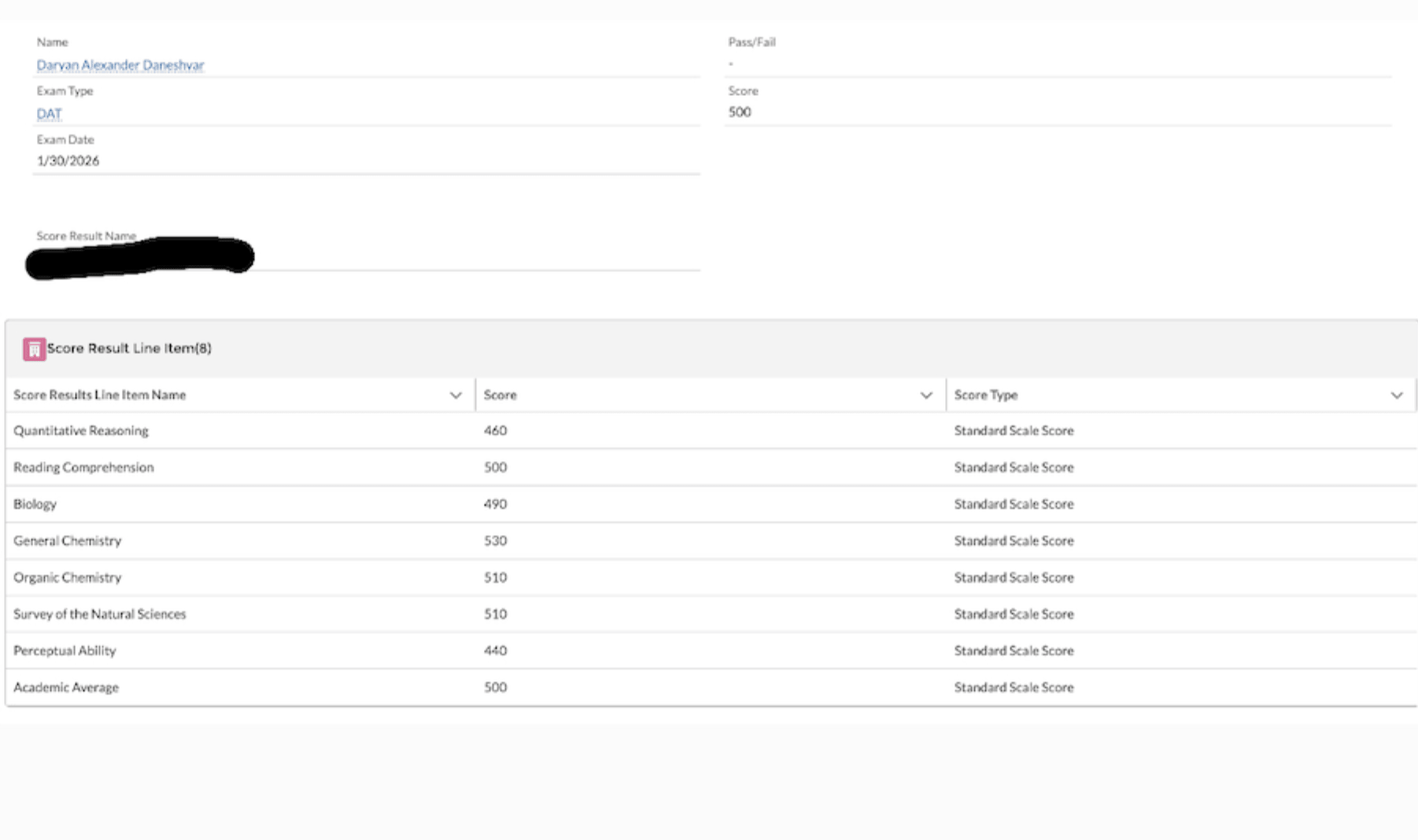
For General Chemistry, I relied almost entirely on Dr. Mike’s Bootcamp video lectures. I watched the videos carefully and took detailed notes, and his explanations made even complex topics intuitive. After completing the videos, I reinforced my understanding through Bootcamp practice exams, which I found to be very representative of the real test. This preparation helped me achieve my highest subsection score of 530 in General Chemistry.
Organic Chemistry
For this section, I focused primarily on Dr. Mike’s Ultra-High Yield Organic Chemistry note packet and reinforced the material through Bootcamp practice exams. While learning reaction mechanisms is important in many university courses, the DAT often emphasizes recognizing reactants and products rather than recalling every step of a mechanism. Memorizing the reactions in the note packet proved to be extremely effective preparation. Whenever I encountered something I did not fully understand, I returned to Dr. Mike’s videos for clarification.
Perceptual Ability Test (PAT)
The Perceptual Ability Test can feel intimidating at first, but with practice it becomes surprisingly enjoyable. I began by learning the fundamentals through Bootcamp’s instructional videos and then practiced consistently using both practice exams and question banks. One thing that helped me was practicing in different environments. I practiced PAT problems on planes, at the gym, and in coffee shops all around town. Training my brain to think spatially in many environments helped make the skill feel natural. With enough practice, the section started to feel like solving puzzles rather than answering exam questions. Techniques that helped me included practicing Top-Front-End problems until they became intuitive, using the grid technique for hole punching explained on Bootcamp, training my eyes with daily angle ranking practice, applying the side-pairing technique for pattern folding, and using a systematic approach for cube counting. Once you spend a week or two learning the fundamentals, the most important factor becomes consistent practice. I actually treated PAT practice as a reward at the end of my study day.
Reading Comprehension
For Reading Comprehension, the most important habit was simply reading actively every day. Early in my preparation, I did not always complete full reading sections. I often selected a single passage from Bootcamp practice exams and focused on mastering it. Closer to my exam date, I transitioned to completing full-length sections. My approach was to read the introduction carefully, skim the body paragraphs, read the conclusion, and identify the author’s tone and main theme. While reading, I used the highlight feature to mark important keywords, dates, names, and statements that stood out. The goal is to understand the structure of the passage so that when you begin answering questions, you already know where to return for the information you need. For the final passage on my real DAT, I used a search-and-destroy strategy and performed very well in the section overall. I also highly recommend Bootcamp’s Daily Reading Practice feature, which links to ScienceDaily articles. These readings help build comfort with scientific writing and reinforce the habit of active reading.
Quantitative Reasoning
Quantitative Reasoning was one of the more straightforward sections once I became familiar with the common problem types. I watched the Bootcamp QR videos and practiced primarily through the practice exams and question banks. Many of the problems involved probability concepts such as cards or marbles, combinations and permutations, standard deviation calculations, and combined rate problems. One resource that helped tremendously was Bootcamp’s QR formula cheat sheet. Mastering those formulas made the section far more manageable.
Overall
One of the most important strategies on test day is not getting stuck on difficult questions. If a problem does not immediately make sense, it is perfectly fine to skip it and move forward. Early in the exam, nerves can make questions feel harder than they actually are. When you return to them later, you will often realize that you know the answer after all. Moving through the questions you are confident about first helps build momentum and familiarity with the exam, which makes the more difficult questions easier to approach when you come back to them.
The DAT can feel overwhelming at first, but with the right preparation strategy it becomes very manageable. Focus on consistent daily study, spaced repetition, and building a toolbox of strategies rather than trying to memorize everything at once. Most importantly, maintain discipline while allowing yourself occasional breaks to reset and stay motivated. Bootcamp was an incredible resource throughout my preparation, and I highly recommend it to anyone preparing for the DAT.


.jpg)


.jpg)


.jpg)
.jpg)
%20(1).jpg)
.jpg)



